
Market Projections & Outlook
RWA Projections 2026–2030: From $26 Billion Today to Multi-Trillion Scale
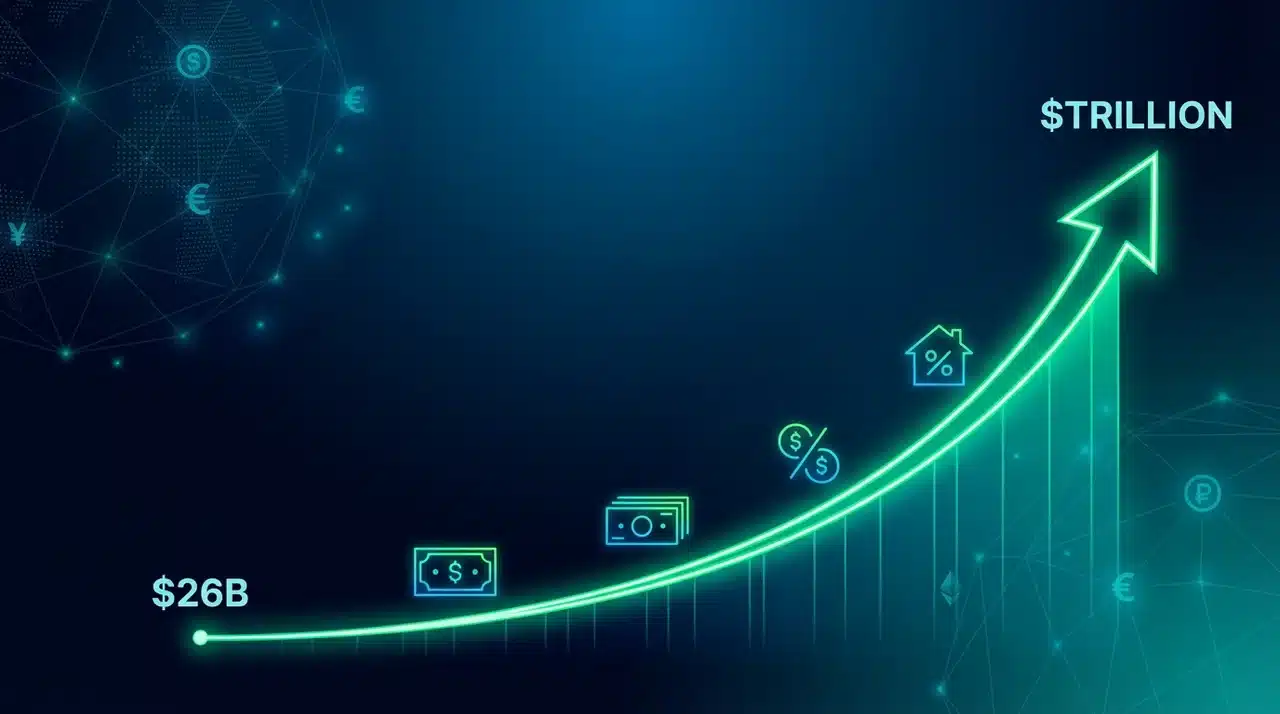
The tokenized real world assets (RWA) market continues to show strong momentum in March 2026. As of the latest data from rwa.xyz, the distributed RWA market (excluding stablecoins) stands at approximately $26.65 billion, marking a 6.4% increase over the past 30 days. The broader represented asset value, including all tokenized assets, is closer to $387 billion. Tokenized U.S. Treasuries lead the way at $11.65 billion, with Circle’s USYC at $2.4 billion and BlackRock’s BUIDL at $2 billion. Commodities, asset-backed credit, and non-U.S. government debt fill out the top categories.
These figures represent significant growth from earlier 2026 levels, but they remain a small fraction of global financial assets. Multiple independent forecasts now project the tokenized RWA market reaching multi-trillion-dollar scale over the coming years, driven by regulatory clarity, institutional participation, and technological maturation.
Key Projections from Major Research Firms
ARK Invest’s Big Ideas 2026 report estimates tokenized assets could reach $11 trillion by 2030. This forecast is based on accelerating adoption in U.S. Treasuries and sovereign debt, followed by bank deposits and public equities as institutions shift from pilot programs to meaningful allocations. The $11 trillion figure implies roughly 500x growth from early 2026 levels.
Boston Consulting Group (BCG) and ADDX project a base case of $16 trillion by 2030, with an optimistic scenario reaching $68 trillion. Roland Berger forecasts at least $10.9 trillion by the same year. Standard Chartered anticipates $30.1 trillion by 2034. Citi separates digital securities at roughly $4 trillion and CBDCs at $5 trillion. TD Cowen offers the most aggressive estimate at $100 trillion.
These projections share common drivers: clearer regulatory frameworks (including stablecoin legislation and GENIUS Act progress), institutional inflows from firms such as BlackRock, Franklin Templeton, and State Street, and improvements in tokenization infrastructure that reduce costs and increase speed.
Current Market Breakdown and Growth Drivers
The $26.65 billion distributed RWA market breaks down as follows:
- Tokenized U.S. Treasuries: $11.65 billion (largest category, driven by institutional demand for yield-bearing assets)
- Commodities: significant share dominated by tokenized gold
- Asset-backed credit and private credit: growing rapidly
- Non-U.S. government debt: emerging but smaller
The growth trajectory reflects several structural factors. Tokenization addresses longstanding inefficiencies in traditional finance: multi-day settlements, high intermediary fees, limited fractional ownership, and restricted access. Blockchain enables instant settlement, 24/7 trading, transparent on-chain ownership, and global participation without geographic barriers.
Stablecoins serve as the foundational layer, providing the stable cash equivalent needed for RWA transactions. As stablecoin volumes continue to expand, they facilitate smoother entry and exit from tokenized positions. Regulatory developments are removing uncertainty, while established financial institutions are launching live products, signaling credibility to broader markets.
Implications for Retail and Institutional Participants
At current scale, tokenized RWAs already offer retail participants access to previously restricted asset classes. Tokenized U.S. Treasuries provide government-backed yields directly in wallets, with no minimum investment beyond gas fees. Private credit and real estate fractions deliver higher potential returns through fractional ownership. As the market grows toward trillions, these opportunities become more liquid, more diverse, and more cost-effective.
Institutional participation accelerates this process. Large players allocate to tokenized assets for portfolio diversification, yield enhancement, and operational efficiency. Their involvement increases liquidity, reduces spreads, and attracts additional capital. Retail participants benefit from the resulting ecosystem improvements: tighter pricing, more reliable on-ramps/off-ramps, and expanded product availability.
The transition from billions to trillions is expected to unfold gradually over 4–8 years. Early categories like Treasuries and stablecoins lead, followed by private credit, real estate, and eventually equities and commodities. Each new category that tokenizes brings additional liquidity and participants, creating a compounding effect.
Risks and Considerations
While projections are consistent across major firms, risks remain. Regulatory changes could alter timelines or requirements. Smart contract vulnerabilities exist even in audited protocols. Asset performance depends on underlying fundamentals — credit defaults, interest rate shifts, or property market downturns can impact yields. Liquidity in newer categories may remain thin for some time. Diversification and use of established platforms are essential.
Current Positioning and Outlook
The tokenized RWA market sits at $26.65 billion distributed value today, with strong growth in Treasuries and credit. Forecasts ranging from $10 trillion to $30 trillion by 2030–2034 reflect realistic adoption paths given current trends in regulation, institutional flows, and infrastructure.
This scale represents a fundamental shift: from niche experimentation to core financial infrastructure. Tokenized assets are moving from pilot stage to production, with real yields, real ownership, and real accessibility becoming standard.
RWA News Network will continue tracking these developments, including new product launches, regulatory updates, and TVL shifts. Stay subscribed for the latest data and analysis.






Midas Partners With Fasanara Capital to Tokenize Alternative Debt Strategy – RWA News

Franklin Templeton Partners with Ondo Finance to Launch Tokenized ETFs for 24/7 Crypto Wallet Trading – RWA News

NYSE Partners with Securitize to Build 24/7 Tokenized Securities Platform – RWA News March 2026

Ripple Taps Singapore Central Bank Sandbox for RLUSD Stablecoin Trade Finance Test

BNY Mellon CEO Says Big Banks Will Bridge Crypto and Traditional Finance – RWA News

BlackRock CEO Larry Fink and Coinbase CEO Brian Armstrong Both Bullish on Tokenization

Tokenized US Treasuries Reach $11B–$12B Record – Yields & Top Funds

RWA Projections 2026–2030: From $26 Billion Today to Multi-Trillion Scale

Fidelity Calls on SEC to Expand Broker-Dealer Crypto Capabilities via Alternative Trading Systems – RWA News

Robinhood CEO Vlad Tenev Urges CLARITY Act for Stablecoin Yields – RWA Boost in March 2026
BlackRock CEO Larry Fink and Coinbase CEO Brian Armstrong Both Bullish on Tokenization

Tokenized Real World Assets Surge Past $27 Billion in March 2026 – The Quiet Revolution Reshaping Global Finance
-
 Real World Assets4 days ago
Tokenized US Treasuries Reach $11B–$12B Record – Yields & Top Funds
-
Real World Assets3 days ago
Fidelity Calls on SEC to Expand Broker-Dealer Crypto Capabilities via Alternative Trading Systems – RWA News
-
Real World Assets4 days ago
Robinhood CEO Vlad Tenev Urges CLARITY Act for Stablecoin Yields – RWA Boost in March 2026
-
Institutional Bullishness & Tokenization Outlook2 days ago
BlackRock CEO Larry Fink and Coinbase CEO Brian Armstrong Both Bullish on Tokenization
-
Market Data & Insights2 days ago
Tokenized Real World Assets Surge Past $27 Billion in March 2026 – The Quiet Revolution Reshaping Global Finance
-
AI & DeFi Yield Integration4 days ago
OpenLedger Adopts ERC-4626 for AI-Managed DeFi Yield – RWA News
-
Real World Assets4 days ago
Ripple Burns 9M RLUSD – What This Means for Tokenized Stablecoin Liquidity in RWA News 2026
-
Real World Assets4 days ago
VersaBank Expands Tokenized Deposits with Cross-Border FX – RWA News