Market Growth & Performance
Robinhood Pulls In $70 Billion in Deposits This Year While Betting Harder on Tokenized Stocks

Robinhood’s latest operating update landed on a day the stock was already moving. Shares closed near $85 after the company said year-to-date net deposits through October had reached roughly $70 billion. October alone contributed around $15 billion. Of that October total, about $6.5 billion came from Trump Accounts, bringing the year-to-date contribution from those accounts to roughly $9 billion.
The trading side of the business was more mixed. Equity notional volume held steady near $325 billion for the month. Options contracts came in around 289 million. Event contracts were the clear standout, rising 136% year-over-year to 5.9 billion. Crypto notional volume, by contrast, dropped sharply—down 21% month-over-month and 48% from a year earlier. The company has been open that crypto has been softer while other areas, particularly event contracts and the newer account flows, have carried more of the growth.
What stands out in the numbers is how much of the deposit strength is coming from products that sit outside traditional trading commissions. Trump Accounts are a government-linked savings vehicle. Robinhood is one of the main brokers handling them. The company has said it is investing around $100 million this year in the effort, and the inflows have already shown up in the monthly deposit figures. Whether those balances stay and generate ongoing revenue is a longer-term question, but they are clearly moving the near-term deposit metrics.
The part of the story that connects most directly to tokenized assets is the commentary around Robinhood Chain. Johann Kerbrat, SVP of International and Crypto, has continued to frame the chain as a way to lower barriers and open access to tokenized products for a broader set of users. The chain launched on mainnet on July 1. By early November it was reporting roughly $1.06 billion in DeFi total value locked on DefiLlama, with stablecoin balances near $1 billion and daily DEX volume in the hundreds of millions. Those figures are still early relative to the company’s overall platform assets, but they represent real activity on a network that did not exist six months earlier.
what are you tokenizing?
— Robinhood Crypto (@RobinhoodCrypto) November 11, 2026
Stock Tokens remain the most visible product on the chain. They are structured as tokenized debt securities that track the economic performance of underlying U.S. equities and ETFs. Holders can trade them outside normal market hours and, in some cases, use them as collateral in onchain lending. They do not confer traditional shareholder rights. That distinction has been noted by regulators and by other tokenization projects that are pursuing different structures. For Robinhood, the trade-off appears to be speed of distribution and 24/7 tradability across more than 120 countries outside the United States.
Kerbrat has said publicly that a large share of Stock Token trading already happens outside regular exchange hours. That usage pattern is one of the clearer signals that the product is filling a gap the traditional market does not currently cover. It also explains why the company keeps emphasizing the chain even while core brokerage volumes are only modestly higher year-over-year. The chain is not yet a major revenue line, but it is the piece of the business that is expanding the set of things customers can do with the assets they hold.
The deposit numbers and the onchain metrics are not the same story, but they are related. Strong inflows give Robinhood more assets it can eventually route into tokenized products or related yield and collateral use cases. At the same time, the chain gives the company a place to offer features—continuous trading, onchain collateral, third-party integrations—that are harder to deliver inside a traditional brokerage account. Whether those two efforts reinforce each other over the next few quarters is still being tested.
Shares have moved around these updates. The stock closed near $85 after the October data, up from the prior session. It remains well below its earlier-year highs, which is consistent with a market that has already priced in a lot of the growth narrative and is now watching whether the newer lines (event contracts, Trump Accounts, and the chain) can offset softer areas such as crypto trading. The company has 14 business lines that have reached at least $100 million in annualized revenue, according to its most recent quarterly commentary. That diversification is what management points to when volumes in any single product slow.
For readers tracking tokenized equities, the practical takeaway is narrower. Robinhood is one of the few large consumer platforms that has actually shipped tokenized stock exposure to a wide international audience and put it on a chain that third-party apps can build on. The October deposit figures show the company is still adding assets at a healthy rate. The chain figures show that a portion of activity is already happening onchain. How much of the new deposits eventually interact with Stock Tokens or other tokenized products is not yet clear from the public data, but the company is building the infrastructure for that interaction in parallel with the deposit growth.
The next few monthly updates will show whether the October strength was concentrated in the Trump Accounts contribution or whether broader customer inflows are holding up. They will also show whether activity on Robinhood Chain continues to scale while traditional crypto volumes remain under pressure. Both numbers matter for anyone watching how large consumer platforms are approaching tokenized assets.













Solana
Solana Breakpoint 2026 Is About to Start in London – Here’s Who Has the Most Hype and What They’re Shipping
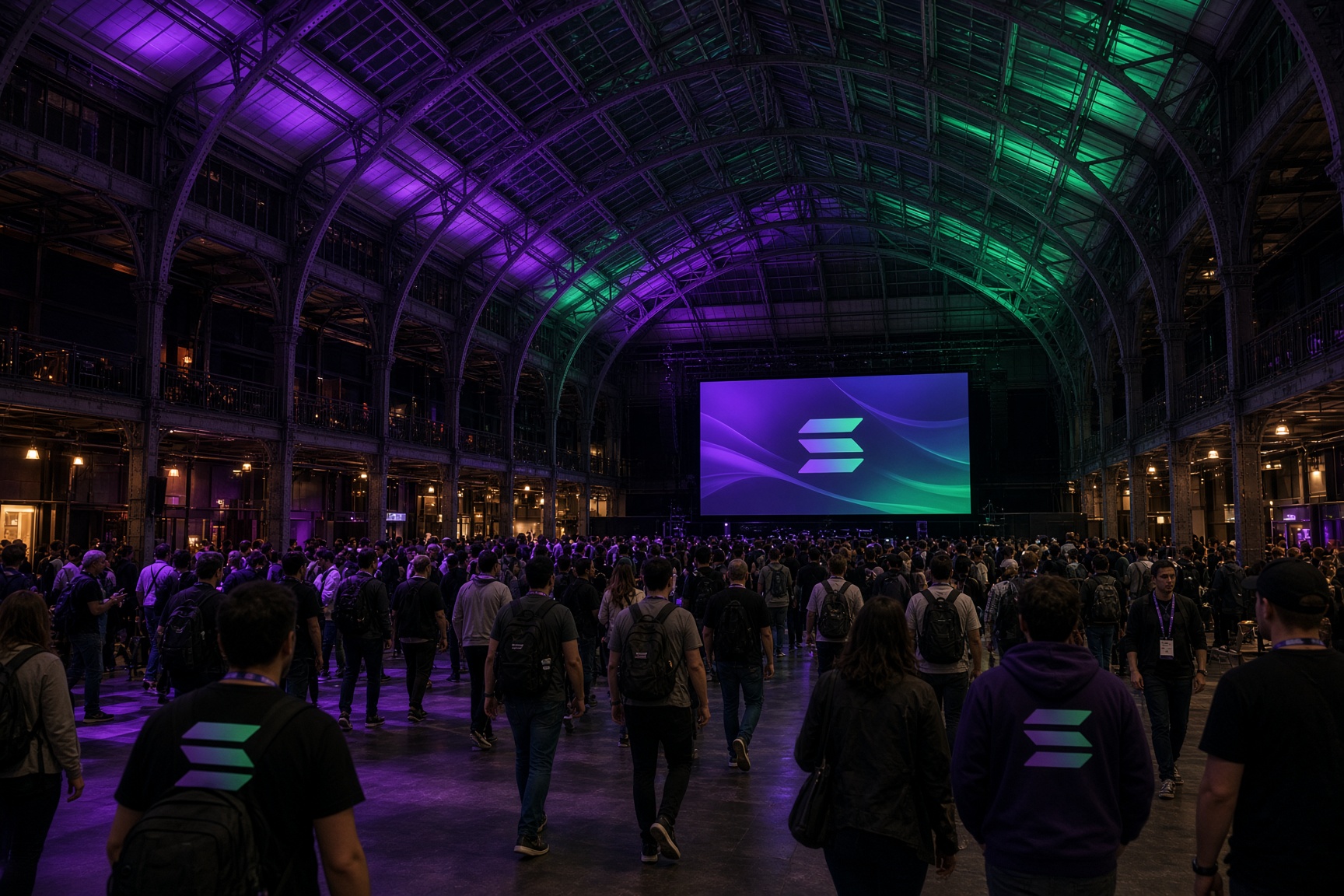
Solana Breakpoint 2026 starts tomorrow in London. The three-day conference runs November 15–17 at Olympia London, and the Solana Foundation is expecting more than 8,000 people from over 100 countries. It is the first time the annual event has been held in the UK. The official theme is the Token Supercycle – stablecoins, tokenized assets, payments, and AI-driven activity moving onchain. Side events have already been running for two weeks, including the Hacker House, Demo Day, the Intelligence Summit, and Scale or Die.
On X the pre-event conversation has been loud. Solflare has one of the most visible activations: a $150,000 merch drop tied to its new Community Hub. People are posting about claiming items and the bandana-style campaign that started earlier. Jupiter has been teasing a cluster of product releases under an “Aggregate Everything” banner – Pulse for token search, Baskets, Vaults, and Portfolio V3 with deeper program integrations. Those posts have been circulating steadily in the days leading into the event.
More Breakpoint 2026 speakers are confirmed.
London’s Deputy Mayor joins leaders from SoFi, Formation, MoonPay & more on the Breakpoint stage in London this week.
Howard Dawber, Deputy Mayor of London
Simon Griffin, @SoFi
Gordon Corera, The Rest Is Classified
Nikou Asgari, @FT
Chris Montagano, @formation_so
Halsey Huth, @moonpay
Chris Osborn, @leapxyz— Solana (@solana) November 14, 2026
Helius has drawn attention for its privacy work. The team launched native privacy rings on Solana mainnet, enabling encrypted balances and shielded transfers with compliance controls. That landed as a concrete technical update rather than pure hype, and it has been referenced in multiple roundups of what is shipping around Breakpoint. Solana Mobile is also out in force with the Seeker device. Team members have been posting about side quests, merch, and interviews with builders shipping for the phone. The Clockwork Hackathon with RadiantsDAO wrapped recently with $125K in USDC plus SKR and ORE prizes, which added another layer of builder activity right before the main conference.
Tokenized assets are getting airtime because of specific projects. Backpack’s Armani Ferrante is speaking; the company issues 1:1 backed tokenized stocks on Solana. Leap, a new trading app from Solana Labs for tokenized stocks, ETFs, commodities, currencies, and crypto, is also on the agenda. Chris Osborn is scheduled to talk about high-performance trading built entirely on Solana. Formation Securities has been mentioned in connection with plans for a tokenized securities venue. These fit the Token Supercycle framing and have been called out in posts listing the teams people most want to see.
Other names showing up in the speaker and activation mix include MoonPay’s PayBox for AI agents settling on Solana, KAST setting up an actual coffee shop inside the venue on the 16th and 17th with a card hunt, and continued mentions of Jito, Sunrise, and various payment and RWA-related teams. The speaker list has grown to include traditional finance and policy names – Revolut’s chair, former UK officials, Zelle, and others – which has fed the “institutions are actually showing up” narrative on the timeline.
The market backdrop is mixed. Bitcoin has been under pressure below $68K on inflation data, Fed hike odds, ETF outflows, and the Nvidia leadership situation, and SOL has traded near the low-to-mid $70s heading into the event. That has not stopped the on-the-ground posts from people who have already landed in London. The combination of concrete product updates (Jupiter’s suite, Helius privacy, Leap, Solflare merch) and the sheer density of side events is what has generated the most consistent traction on X so far.
Whether any of these announcements move the needle once the keynotes start is still ahead. The pre-event signal has been clear: the projects shipping usable tools around tokenized assets, privacy, mobile, and payments are the ones getting the most repeated mentions. Breakpoint is the concentrated moment where a lot of that work becomes visible at once.
Raydium and Sunrise
Raydium is on the ground. One of the team members posted earlier today that he had just landed in London after a long travel day and that Breakpoint vibes were already setting in. The DEX has also been one of the main venues for tokenized equity trading volume on Solana, recently passing $8 billion cumulative, and it continues to be the primary liquidity home for many of the assets Sunrise lists.
Made it to London after an insane day of travel.
Breakpoint vibes are setting in.
— Infra | Raydium (@0xINFRA) November 14, 2026
Sunrise confirmed it is attending and has a main-stage keynote. The team posted “Sunrise coded. See you all in London for Breakpoint,” and their CEO is scheduled to speak on “The Capital Market Wars,” covering tokenization and global distribution of assets onto Solana. Sunrise has been the consistent front door for bringing stocks, commodities, and other assets live on Solana with immediate liquidity, so their presence fits the Token Supercycle theme directly.
Sunrise coded.
See you all in London for Breakpoint. ↓ https://t.co/4BIA6i5Me1
— Sunrise (@sunrise) November 6, 2026
Market Data & Insights
Bitcoin Crashes Below $68K as Inflation, Fed Hike Bets, ETF Outflows and Nvidia Shock Hit Crypto Hard

Bitcoin broke below $68,000 late on November 13 and continued trading in that range into the early hours of the 14th, with some venues printing near $67,500. The move took the largest cryptocurrency back to levels last seen in mid-August and capped a multi-day slide that had already been building. Once the $70,000 level gave way, leveraged longs started getting forced out, and the selling accelerated.
The pressure arrived from several directions at the same time. October CPI data released earlier in the week showed headline prices rising 0.4% month-over-month and core inflation up 0.3%, both hotter than consensus. Markets quickly repriced the path for Federal Reserve policy. Probability of a 25-basis-point hike in December climbed above 85% and in some measures near 90%, with discussion of a larger 50-basis-point move circulating after comments from Fed officials. Treasury yields moved higher—the 10-year briefly touched around 5.15%—and the Dollar Index pushed above 103, its strongest level in months. Higher yields and a stronger dollar typically weigh on non-yielding assets like Bitcoin, and this week was no exception.
Spot Bitcoin ETFs added another layer of selling. The funds recorded multiple consecutive days of net outflows totaling roughly $1.4 billion over a five-day stretch ending around November 11, with additional redemptions continuing afterward. BlackRock’s IBIT accounted for the bulk of the withdrawals in several sessions and has been on a multi-day outflow streak. Net assets in the category have fallen well off their peak, and the flow picture has turned negative for the year so far. Institutional buyers who had been a consistent source of demand earlier in the cycle have stepped back, removing one of the steadier bid layers the market had grown used to.
The Nvidia situation landed on top of an already fragile tape. Jensen Huang’s resignation as CEO, president, and board member on November 12 triggered a sharp drop in Nvidia shares and spilled into broader risk sentiment. The stock, which had already been sliding from its October highs, fell hard on the news before recovering some ground. Crypto-native venues saw related moves in tokenized Nvidia exposure and perpetual futures. Bitcoin mining companies with AI data-center exposure also sold off. For a market that has increasingly traded alongside the AI narrative and high-beta tech, the leadership shock at the center of that narrative reinforced the risk-off move.
The combination produced a classic cascade. CoinGlass and other trackers recorded more than $1.3 billion in crypto futures liquidations over 24 hours, with some snapshots climbing toward $1.6 billion. The vast majority were long positions. Bitcoin alone accounted for hundreds of millions of that total. A single large long on Hyperliquid was reported around $31 million. Funding rates on perpetual futures turned negative near the $68,500 area for the first time in about a month, signaling a shift toward more defensive positioning. Ethereum slipped below $2,000, Solana traded under $80 at points, and most major altcoins followed lower. Total crypto market capitalization fell several percent in a single session.
The 200-week moving average, which had been watched as a longer-term reference near $68,000, was tested and briefly broken. Thin order books after earlier selling made the moves sharper once the liquidations started. None of these factors is permanent on its own. Inflation data are backward-looking, Fed pricing can shift with the next print, ETF flows have reversed before, and Nvidia continues to ship the GPUs that power AI infrastructure under interim leadership. What the market is currently digesting is the simultaneous appearance of hotter inflation, higher rate expectations, a stronger dollar, sustained ETF outflows, heavy long liquidations, and a high-profile leadership event in the AI complex that crypto has been correlated with.
Until one or more of those pressures ease, the path of least resistance has been lower. Bitcoin is now trading at its lowest levels in roughly three months. The next few sessions will show whether buyers step in around the current zone or whether the combination of macro, flow, and technical headwinds keeps the pressure on. The ingredients for the drop were all visible at once, and the market priced them in together.
Institutional Tokenization & ETF Innovation
OKX and NYSE Parent ICE Set November 23 Launch for Tokenized Securities Venue After Dozens of Issuers Opt Out

OKX and Intercontinental Exchange, the parent company of the New York Stock Exchange, said on November 11 that their joint venture OKXICE will open its Tokenized Securities Venue for trading on November 23. Eligible U.S. customers will be able to trade tokenized versions of U.S. securities around the clock through the OKX app under the SEC’s Innovation Exemption.
The venture has confirmed more than 70 assets so far. Named issuers include Better.com, BitGo, Circle, Coinbase, Robinhood, Securitize and Strategy. Strategy will also list preferred shares, including products tied to its digital credit offerings. The roster is filled out by 59 exchange-traded funds from Direxion, an issuer known for leveraged and inverse products. Not every confirmed asset is guaranteed to trade on the first day.
The launch comes after significant pushback. Of the companies originally proposed, the large majority objected to having their shares tokenized on the venue. A public notice dated November 5 listed 67 issuers that had sent notices of objection, among them Apple, Amazon, Tesla, Meta, Microsoft, Alphabet and Goldman Sachs. Only a handful of the original names remain, most of them crypto-related or adjacent firms. Robinhood was among those that did not object; a spokesperson previously said the company would rather help build tokenized markets than sit on the sidelines.
OKXICE is a 50-50 joint venture formed after ICE invested in OKX. Trading will take place through permissioned automated market maker pools built on Uniswap v4 on X Layer, OKX’s Ethereum Layer 2. Customers will hold the tokens in self-custodial wallets. The venue itself will not custody assets or private keys. Access is limited to eligible U.S.-based OKX Inc. customers who complete onboarding, activate a CeDeFi Wallet and meet identity and geographic requirements. Smart contracts restrict trading and liquidity provision to approved wallets.
ICE and Trade[XYZ] plan to bring Hyperliquid-based perps to the U.S.
Subject to regulatory approvals, ICE will operate U.S. regulated versions of Trade[XYZ]’s markets, leveraging their expertise as the leading deployer of real-world-asset perps on Hyperliquid.
The new venue will operate separately to ICE’s institutional futures franchise and offer a trading experience designed for retail participation.
Once live, U.S. traders will be able to trade 24/7 across a range of assets spanning the macro complex including:
*Crypto
*Equities
*Indices
*Commodities
*ForexRead more: https://t.co/iJsj6Cyp9i
Users will access the platform through U.S.-regulated FCMs performing KYC/AML screening, including ICE’s joint venture with OKX.
ICE and Trade[XYZ] will seek approvals to launch a new market built on Hyperliquid to operate KYC-compliant perp markets, including regulatory approvals to support leveraged trading.
— ICE (@ICE_Markets) October 31, 2026
The tokens are intended to carry the same economic and shareholder rights as the underlying securities, including dividends, voting and participation in corporate actions. The structure relies on the temporary Innovation Exemption the SEC issued in September 2026, which allows qualifying venues to offer secondary trading of tokenized National Market System stocks through permissioned pools without full exchange registration, provided certain conditions are met.
The November 23 date marks one of the more concrete near-term launches under the exemption. Earlier this week Formation Securities notified the SEC of its own plans for a Solana-based venue targeting early 2027, and other platforms have been expanding tokenized stock offerings. The OKXICE opening will test how much volume and interest a 24/7 onchain venue can attract when the available names are largely limited to companies that have consented, rather than the broadest set of U.S. stocks.
For now the lineup is heavily weighted toward crypto-native and adjacent issuers plus a large block of Direxion ETFs. Whether that mix is enough to draw meaningful trading once the venue is live, and how the tokens behave relative to the underlying shares outside regular market hours, will become clearer after November 23.

Solana Breakpoint 2026 Is About to Start in London – Here’s Who Has the Most Hype and What They’re Shipping

Bitcoin Crashes Below $68K as Inflation, Fed Hike Bets, ETF Outflows and Nvidia Shock Hit Crypto Hard

Litecoin Just Took a Major Step Toward Smart Contracts – Mainnet Is Getting Closer

RWA Projections 2026–2030: From $26 Billion Today to Multi-Trillion Scale

Tokenized US Treasuries Reach $11B–$12B Record – Yields & Top Funds

Tokenized Real World Assets Surge Past $27 Billion in March 2026 – The Quiet Revolution Reshaping Global Finance
-
 Market Projections & Outlook8 months ago
RWA Projections 2026–2030: From $26 Billion Today to Multi-Trillion Scale
-
Real World Assets8 months ago
Tokenized US Treasuries Reach $11B–$12B Record – Yields & Top Funds
-
Market Data & Insights8 months ago
Tokenized Real World Assets Surge Past $27 Billion in March 2026 – The Quiet Revolution Reshaping Global Finance
-
Institutional & Collateral Updates8 months ago
JPMorgan Now Accepting Bitcoin and Ethereum as Institutional Collateral – RWA News March 2026
-
Real World Assets8 months ago
Robinhood CEO Vlad Tenev Urges CLARITY Act for Stablecoin Yields – RWA Boost in March 2026
-
Litecoin2 days ago
Litecoin Just Took a Major Step Toward Smart Contracts – Mainnet Is Getting Closer
-
NFTs5 days ago
ITIA Opens Whitelist for Free 1,111-Piece Genesis Collection on Ethereum as Applications Surpass 25,000
-
Market Growth & Performance6 days ago
Robinhood Chain’s Stock Tokens Now Sit in Nearly 1.7 Million Wallets